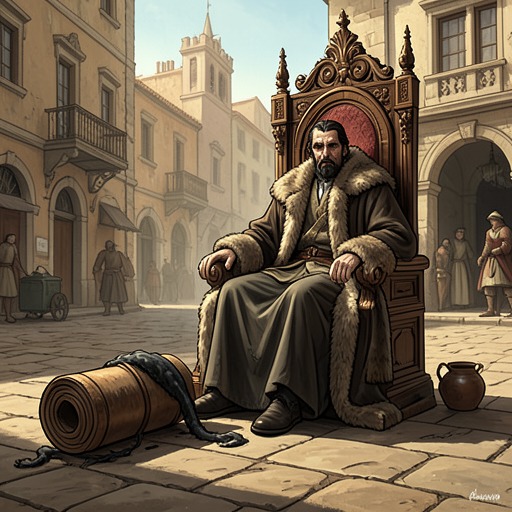
Louis XII of France
The PrinceLouis XII of France is the book’s principal case study in the failure to retain a newly acquired foreign state. He gained Milan rapidly, but his conquest proved unstable because he neglected the political conditions that make acquisition durable. By strengthening the Church, inviting Spain into the Kingdom of Naples, failing to settle in Italy or establish colonies, and destroying the Venetian counterweight, he converted military opportunity into strategic isolation and ultimately lost Lombardy.
Identity and Political Position
Louis XII of France appears as the French king whose longer possession of Italy makes his conduct especially legible. The narrator deliberately distinguishes him from Charles VIII of France: Louis held Italy for a longer period, so his methods reveal more clearly how a ruler can undo an apparently successful conquest. His entry into Italy was enabled by the ambition of Venice, whose rulers hoped that French intervention would win them half of Lombardy. Although the narrator does not condemn Louis for accepting this alliance, the king entered a country in which France had few friends and in which Charles VIII of France had left every door closed.
Louis’s first advance nevertheless seemed triumphant. On recovering Lombardy, he restored the political credit that Charles VIII of France had lost. Genoa submitted, Florence reached terms, and the Marquis of Mantua, the Duke of Ferrara, the Bentivogli, the Countess of Forli, the Lords of Faenza, Pesaro, Rimini, Camerino, and Piombino, and the citizens of Lucca, Pisa, and Siena offered friendship. Venice, having made the French king master of two-thirds of Italy in exchange for a couple of towns in Lombardy, had reason to regret the bargain.
Conquest and the Loss of Milan
Louis’s first possession of Milan was lost with striking speed. The Milanese had opened their gates to the French king because they expected future benefits, but when those expectations were disappointed, they could not endure the insolence of the new ruler. Their reversal illustrates the danger of a mixed principality: subjects who assist an invader in the hope of improving their condition may discover that the new government burdens them with troops and other vexations, while the conquered population becomes hostile and the former allies cannot be rewarded as they expect.
Ludovico Sforza was therefore able to recover Milan with his own forces alone. The episode shows that Louis had not yet consolidated the goodwill of the inhabitants or built institutions capable of surviving a sudden change in allegiance. A rebellion, once suppressed, can make a state harder to lose because the ruler can punish the guilty, investigate the suspected, and strengthen weak points. But Milan’s first loss occurred before such consolidation had taken place; a warning raised on the frontier was enough for Ludovico Sforza to wrest the city from France.
The second loss required a far greater reversal. After Milan had been recovered once, the whole world had to be ranged against France, and French armies had to be destroyed and driven out of Italy. Yet Milan was lost to Louis again. The repeated reversals distinguish the immediate vulnerability of his first conquest from the deeper consequences of his later policy: he failed not merely through bad fortune, but through a chain of decisions that made the surrounding political order hostile to French power.
Strategic Errors in Italy
The narrator identifies five principal errors in Louis’s conduct. He destroyed weaker states, strengthened a prince who was already strong, brought a powerful foreigner into Italy, failed to reside in the country he had conquered, and neglected to send colonies. Each error weakened the network on which his authority depended. His initial friends were weak and fearful—some connected with the Church, others with Venice—and therefore had to attach themselves to him. Their numbers could have helped him resist any other powerful state, but he failed to protect them.
Louis’s most consequential early mistake was helping Pope Alexander VI occupy Romagna. By supporting this enterprise, he alienated friends who had placed themselves under French protection while adding temporal power to the Church’s already formidable spiritual authority. Instead of preserving a balance favorable to France, Louis strengthened a rival center of power. The consequences forced him into further intervention: in order to restrain Pope Alexander VI and prevent him from becoming master of Tuscany, Louis had eventually to return to Italy himself.
His desire to possess the Kingdom of Naples produced another strategic reversal. Rather than leaving a king willing to hold Naples as a tributary, Louis divided the kingdom with Ferdinand II of Aragon. This introduced into Italy a rival strong enough to attract the ambitious and discontented. A ruler whom France might have controlled was displaced for another who could help expel France. The example is used to distinguish legitimate ambition from imprudent persistence: attempts within a prince’s power may win praise, but attempts beyond his power bring both misfortune and blame.
Louis then added a sixth error by depriving Venice of its dominions. If he had not already strengthened the Church and brought Spain into Italy, humbling Venice might have been reasonable or necessary. After those earlier decisions, however, Venice should not have been ruined. While Venice remained powerful, it would have blocked others from attacking Lombardy: it would not have accepted such an enterprise except on terms that made Venice master, while other powers would have been unwilling to seize Lombardy from France merely to hand it to Venice or to confront both powers together. By destroying this counterweight, Louis removed an obstacle that had indirectly protected French authority.
Governance of Newly Acquired States
Louis’s failure is framed against a broader account of mixed principalities. When a newly acquired state shares the conqueror’s language and customs, retention is comparatively easy, especially if its people have not lived in freedom. The old ruling line must be extinguished, but laws and taxes should otherwise remain unchanged so that the new possession can become incorporated into the hereditary dominions. France’s long union with Brittany, Burgundy, Gascony, and Normandy illustrates the relative ease of this arrangement despite minor linguistic differences.
A state with different language, usages, and laws requires greater fortune and political skill. The most effective remedy is for the prince to reside there in person. Residence allows disorders to be detected while still small, prevents officers from pillaging the province, gives inhabitants direct access to the ruler, and makes a foreign attack more difficult. Louis’s failure to live in Italy thus had practical consequences: distant disturbances could grow beyond repair, while local administration could alienate the population without immediate royal correction.
Colonies offered another inexpensive means of control. Settlers placed in one or two strategic locations could become the keys of the province, costing less than a large force and proving more faithful than soldiers. The people displaced from fields and houses would be injured, but they would form only a small, scattered, and impoverished part of the population; those left untouched could be quieted and would fear sharing the dispossessed people’s fate. Louis sent no such colonies, foregoing a durable instrument for holding the territory he had conquered.
The political structure of a conquered state mattered as much as the ruler’s military success. Alexander the Great could secure Asia after defeating Darius III because Darius’s kingdom was governed through a centralized structure in which the sovereign’s destruction removed the principal source of opposition. By contrast, a kingdom like France contained barons with hereditary authority and subjects of their own, allowing discontented nobles to open the way to invasion and later lead resistance. The comparison makes Louis’s Italian failure part of a general distinction between centralized and divided forms of rule rather than an isolated personal accident.
Relations, Reputation, and Historical Judgment
Louis’s choices also illustrate the danger of making another power great. The narrator recalls speaking with Georges d’Amboise at Nantes while Cesare Borgia was occupying Romagna. When Georges d’Amboise claimed that Italians did not understand war, the reply was that the French did not understand statecraft, because they had allowed the Church to become so powerful. The subsequent history appeared to confirm the rebuke: France had helped enlarge both the Church and Spain in Italy, and those powers contributed to France’s ruin.
The resulting principle is broader than Louis’s individual case. A ruler who causes another’s greatness may ultimately be undone, because the rise of the beneficiary must have been produced either by political skill or by force, and either method generates distrust in the person who has been elevated. Louis’s alliance-making therefore contained the seed of its own reversal. His victories gave strength to forces that no longer needed French protection and could eventually turn against French interests.
The book’s judgment is not that Louis lacked opportunity. On the contrary, his early recovery of Lombardy placed weak and fearful allies around him, and the narrator argues that he could readily have made himself secure by protecting them. His failure lay in misreading the relationship between conquest and rule. He treated possession as though it were authority, sacrificed buffers for short-term gains, and repeatedly avoided the immediate burdens of consolidation, only to face a larger war later.
Military Authority and Contrast with Cesare Borgia
Louis’s example is sharpened by the contrasting conduct of Cesare Borgia. Cesare Borgia first entered Romagna with French auxiliary troops and used them to take Imola and Forli. Finding such forces unreliable, he shifted to mercenary troops by hiring the Orsini and Vitelli. When these too proved fickle, false, and treacherous, he dismissed them and relied on troops of his own raising. His reputation increased as he became visibly master of his own forces.
The contrast does not make Louis a simple military coward; it identifies a different failure of political control. Louis repeatedly depended on external arrangements that enlarged rivals or left conquered territories insufficiently rooted in French power. Cesare Borgia, by contrast, treated borrowed and hired forces as temporary instruments and sought an independent military foundation. Louis’s political reputation declined because the structure surrounding his victories advertised dependence, whereas Cesare Borgia’s reputation rose when his forces and resources appeared to be his own.
Louis XII of France therefore remains significant as a negative model of statecraft. His fall follows a recognizable sequence: rapid conquest, disappointed subjects, weakened allies, an aggrandized Church, a powerful Spanish rival, absent residence, missing colonies, and the destruction of Venice. The loss of Lombardy is presented not as an inexplicable turn of Fortune but as the natural consequence of failing to secure a foreign state after taking it. In that sense, Louis’s career supplies the book’s clearest demonstration that the conquest of a principality is only the beginning of rule, and that the ruler who creates the strength of his future enemies prepares his own defeat.